Nobody needs 500 bad songs
Closing the gap between human intent and audio models.
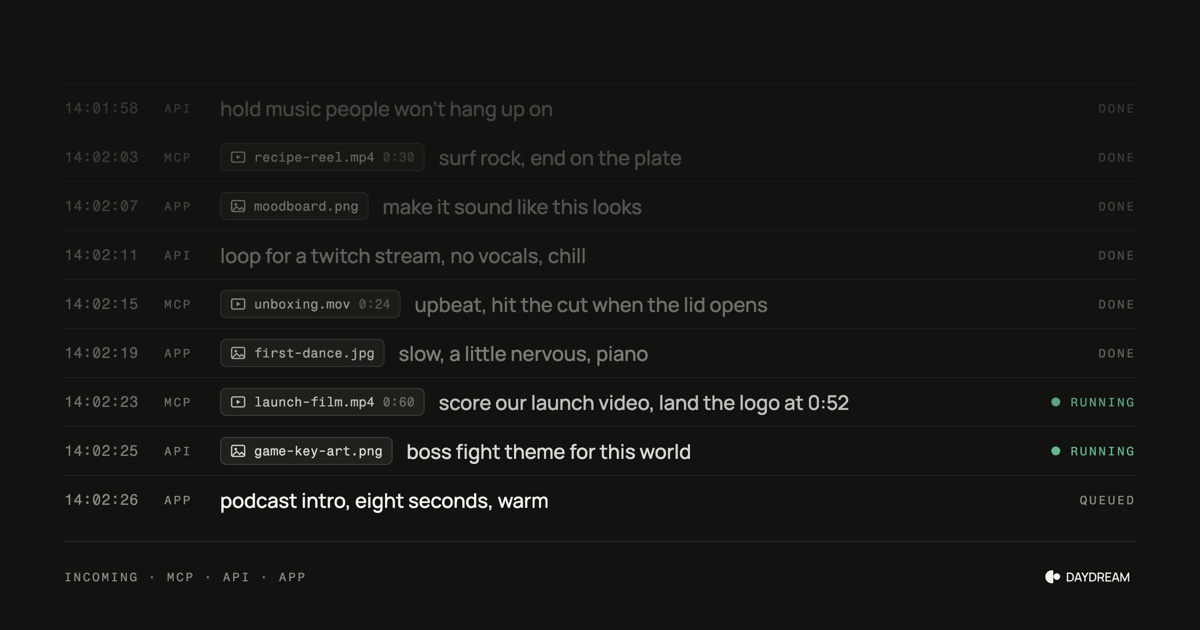
The Daydream team has spent the past few months exploring the frontier of audio generation. During that time, we've talked with musicians, producers, game developers, researchers, tech workers, and everyday music fans. We've heard their frustrations, anxieties, and hopes for the future of generative audio and software in general.
Today, we're sharing a bit about what we've learned and how we expect software to develop in the coming weeks and months.
Agents are coming
We're in a brave new world of software development. Old assumptions about value accrual may not hold: from the "SaaS-pocalypse" to advertising revenue, we've seen value created and destroyed in novel ways.
The music industry is no exception. It is currently embroiled in IP litigation and consumer-grade product development – but there's another wave coming. No one has fully reckoned with the way in which AI will impact the music software landscape.
We've already seen "tool slop" flood the VST market. Most DSP is easily replicable, and it's only a matter of time until someone reverse-engineers Ableton. Music creation is balkanizing: processes have always been personal, and we are now seeing personal software emerge to match individual workflows.
At Daydream, we believe this is only a stopgap. The trend of tool replication is a product of mapping AI onto old workflows and mental models. Much in the same way that AI chafes against old organizational structures, AI-enabled music creation workflows don't transfer cleanly into existing paradigms.
We see a few converging trends that will define the future of digital music.
There will be fewer sticky UIs
Attention spans are dropping. People are driving software through agents and expecting outcomes. This will continue (and become even more common). Certain great UIs will thrive, and prosumer tools may be an exception to this; serious craftsmanship requires serious software and painstaking effort. Still, many people will prefer simplicity and fast gratification.
Model complexity will rise
Much like LLMs, music models will become more powerful, more interesting, and more complex. This will make them more difficult for humans to control effectively, but humans will always want to leverage models to achieve a specific creative outcome.
Human-model interaction will be intermediated
Because of users' rising preference for agentic software and because of the high degree of model complexity, we expect that most people will interface with music models via agents.
Value will accrue to effective harnesses
The winner in any given market will enable effective control of advanced models by humans via agents. In essence, winning products will close the gap between human intent and model outcome.
Song generation is an excellent case study: with due respect to AI music creators, a lot of AI-generated music just sounds ….bad. This is not an indictment of the models, but rather a reflection of the gap between user intent and outcome. Most people simply will not become skilled prompters, work to understand the nuances of models with numerous parameters, and learn a new model every few months.
There are a few solutions to this problem:
- Establish sensible guardrails in consumer offerings. This is what most music-gen tools have done. The problem is that this homogenizes output and limits the expression of inventive creative ideas.
- Nudge people towards prosumer tools (such as DAWs) that allow them to manually manipulate generated output to achieve their goal. This is viable for some people - and can be very powerful! - but is certainly not for everyone.
- Build the best harness for translating human intent into model results.
Why the harness path wins
We believe that the harness path is the most effective route to outsized success across disparate audiences. The music creation audience - which used to be relatively homogenous - is evolving. One example is the arrival of game developers, who used to consume sample packs and partnered with composers if they had the money. With modern generative tools, they can engage directly in music creation and achieve outcomes that are aligned with their creative intent.
As more people participate in creating music, the audience is splitting into distinct groups with very different needs. The first generation of generative music tools does not address this diversity - text-to-song simply does not encompass the variety of creative intent and process, and neither do AI-enabled DAWs.
Guardrails make models easier to use by narrowing what people can make, while prosumer tools preserve creative control but demand time and expertise that most people don't have. A great harness removes that tradeoff, letting people say what they want and pursue it through an agent, without having to master every model or parameter.
The ultimate winner in audio generation will leverage the best harness as a wedge and capture value from every audience:
- DAWs require contextual, musically intelligent generation, and most DAW manufacturers can't or won't compete on generation
- Consumer-grade song generation must produce outcomes that directly serves the broad array of user intent
- Agents operating on behalf of individuals and employees must be able to interact effectively with music models by simply providing context and asking for songs, without specialized musical intelligence.
The musicians, developers, and fans we've spoken to want very different things from this technology, but they share a desire to make something that feels like theirs.
The future of music software belongs to the companies and people who want to create music they're proud to share. That's what we're building toward at Daydream.