What Is an AI Instrument? A Guide for Music Producers
AI instruments bring generative technology into an interactive creative process, giving producers new ways to explore, shape, and direct musical material.
The best audio tools create agency and help producers express their creative ideas.
That principle offers a useful way to think about AI in music production. The more interesting question is what generative technology allows a musician to explore, shape, and direct.
An AI instrument brings generative technology into that relationship.
Rather than treating generation as the final destination, an AI instrument makes it part of an interactive creative process. The producer can influence the material, respond to what they hear, and continue developing the idea.
The technology expands the range of possibilities. The producer gives those possibilities direction.
What is an AI instrument?
An AI instrument is a music-making tool that uses artificial intelligence to generate or transform musical material through controls a musician can actively shape.
The specific interaction can vary. An AI instrument might respond to source audio, MIDI, gestures, performance data, text, or a combination of inputs.
What defines the category is the relationship between the musician and the generative process. The producer can explore the system’s behavior and make creative decisions that influence where the sound goes.
An instrument creates a space for expression. AI instruments extend that relationship into generative technology, giving musicians new material and new ways to shape it.
Agency is a useful measure of generative audio
Generative audio has advanced quickly. Models can now create increasingly complex musical material from different forms of input.
Capability alone, however, tells us relatively little about the experience of making music with those systems.
For producers, more useful questions emerge:
- Can the technology expand the range of an idea?
- Can the producer shape the result with intention?
- Can the same material move in several creative directions?
- Can those decisions become part of a repeatable or performable process?
- Can the output become material for further production?
These questions shift the focus from generation itself to creative agency.
The possibility space of a generative model can be enormous. The design of the instrument determines how meaningfully a producer can move through that space.
A useful AI instrument therefore needs more than impressive output. It needs a relationship between action and result that allows musicians to make intentional creative decisions.
AI is becoming another layer of audio technology
Music technology has always expanded the ways musicians can interact with sound.
Generative audio adds another layer to that evolution by opening sonic possibilities that would otherwise be difficult to reach while giving producers ways to explore and direct them.
A musical phrase might become the foundation for an entirely different instrumentation. A recording might develop into a texture that did not exist in a preset library. Familiar material can move into unfamiliar territory while preserving enough of the original idea to remain creatively useful.
The producer supplies the taste, context, direction, and final decisions. The technology expands the territory those decisions can reach.
Thinking about AI as audio technology shifts the focus from generation itself toward what musicians can create with it.
Every new technology introduces possibilities. Musicians turn those possibilities into techniques, sounds, genres, and eventually culture.
AI instruments have the potential to follow the same path.
From generation to an instrument
An AI instrument and an AI music generator can use related underlying technology while creating different experiences.
A generator is generally oriented toward producing an outcome from a request or set of conditions.
An instrument creates an environment for continued interaction with the sound.
That interaction might involve transforming material, adjusting parameters, performing changes, automating movement, or repeatedly exploring different directions from the same starting point.
Both approaches can have a place in music creation. The distinction is useful because they support different creative relationships with generative technology.
For an instrument, the generated material becomes something to work with.
A producer can learn how the system responds, discover unexpected uses, and turn controls into part of a performance or production technique.
That transition—from generating an output to developing a relationship with a tool—is what makes the idea of an AI instrument compelling.
What makes an AI instrument useful?
The quality of an AI instrument ultimately depends on the creative decisions it makes available.
- Range matters. The technology should open possibilities that meaningfully extend what a producer can explore.
- Control matters. Producers need ways to influence how generated material develops.
- Responsiveness matters. The relationship between action and sound should support experimentation and iteration.
- Integration matters. Generative possibilities become more useful when they can participate naturally in the broader production process.
- Repeatability matters. Controls that can be performed, automated, mapped, or revisited allow experimentation to develop into technique.
Together, these qualities turn generative capability into something closer to an instrument.
Generative audio can expand the material producers have to explore while giving them new ways to shape and direct it. The more control musicians have over that process, the more room there is for taste, technique, and individual expression to shape the result.
DreamSampler as an AI instrument
DreamSampler represents Daydream’s approach to this idea.
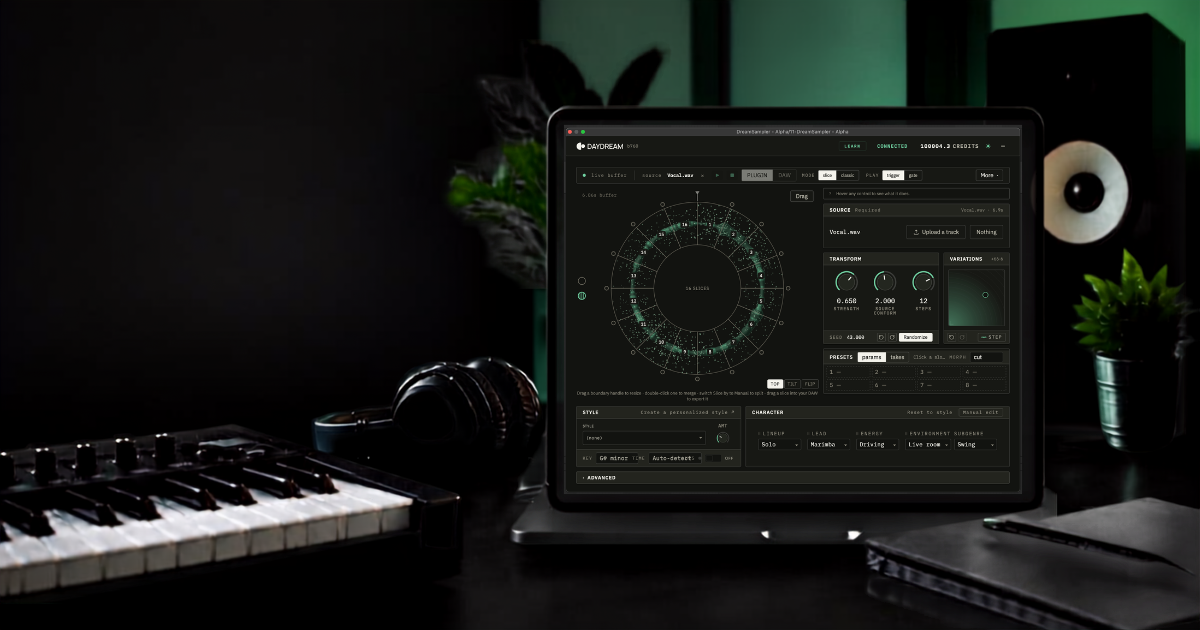
The producer begins with their own audio—a take, loop, field recording, stem, mix, or another source—and uses generative technology to explore what that material can become.
Controls including Strength, Source Conform, Styles, and Character give producers ways to shape the relationship between the source and generated material. DAW automation and MIDI control extend those decisions into the production process.
The source provides creative context. Generative technology expands the possible directions. The producer determines which directions are worth pursuing.
A hummed phrase can suggest an instrumentation the producer did not originally perform. A vocal can become the foundation for a new texture. A field recording can develop into musical material that bears a different relationship to its source.
DreamSampler is one example of how generative audio can function as an instrument rather than simply a source of generated results.
The next generation of audio tools should expand what musicians can explore and express
Technical capability is only part of what will determine which generative tools become meaningful to musicians.
The more important question is what producers can learn to do with them.
The strongest audio tools become extensions of creative intent. Musicians find their own uses for them and incorporate those possibilities into a personal way of working.
AI instruments create an opportunity to bring that relationship to generative audio.
Generative audio has the potential to expand what musicians can explore and express. We’re interested in building instruments that put those possibilities in their hands.
Frequently Asked Questions
What is an AI instrument?
An AI instrument is a music-making tool that uses artificial intelligence to generate or transform musical material while giving the musician meaningful ways to shape the result. Inputs can include audio, MIDI, gestures, performance data, text, or other forms of creative control.
How is an AI instrument different from an AI music generator?
The distinction is primarily in the interaction. An AI music generator is generally oriented toward producing an output from a request or set of conditions. An AI instrument emphasizes continued interaction, allowing musicians to explore, shape, perform, or develop generated material throughout the creative process.
Does an AI instrument need source audio?
No. AI instruments can use different forms of input depending on their design. DreamSampler specifically begins with producer-supplied audio and uses generative technology to transform that material in new directions.
What can producers use AI instruments for?
Depending on the instrument, generative technology can support sound design, audio transformation, sample creation, experimentation with instrumentation and texture, performance, and other forms of musical exploration.
Is DreamSampler an AI instrument?
DreamSampler is Daydream’s generative instrument for music producers. It uses producer-supplied audio as a starting point and provides controls including Strength, Source Conform, Styles, and Character, along with DAW automation and MIDI control, to shape generated material throughout the creative process.